
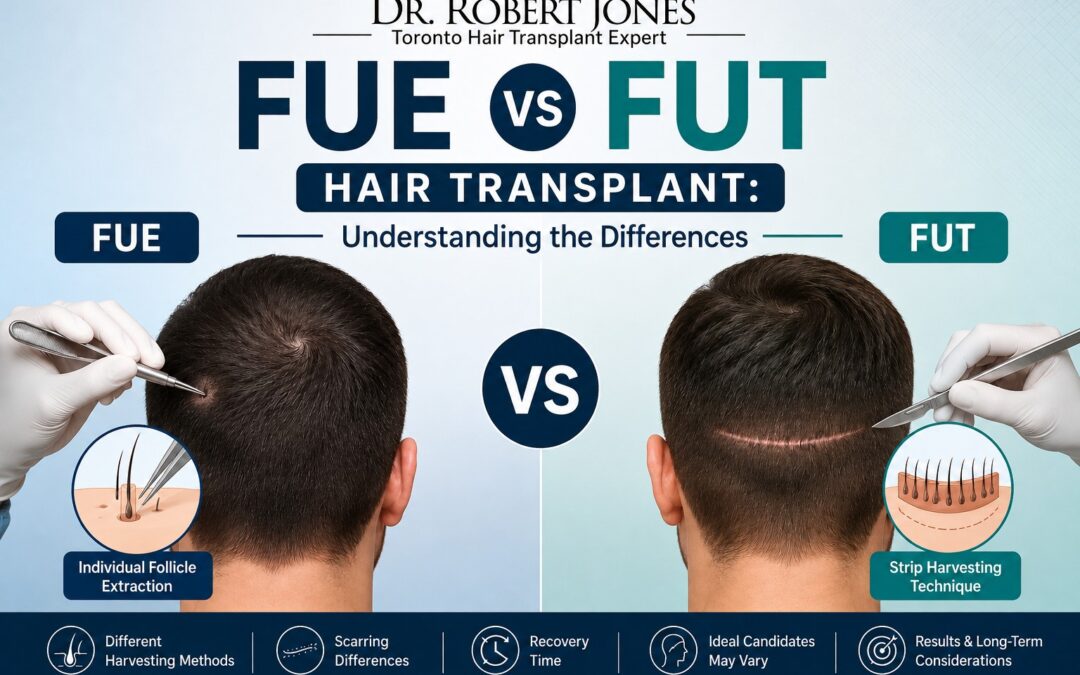
Choosing between FUE and FUT hair transplantation is an important part of the hair restoration process. Both techniques involve moving healthy hair follicles from a donor area to areas affected by thinning or hair loss, but they use different methods to collect the donor hair.
Understanding these differences can help you make a more informed decision and discuss your options with a qualified hair restoration professional.
What Is an FUE Hair Transplant?
FUE, commonly known as Follicular Unit Extraction, is a hair transplant technique in which individual follicular units are removed from the donor area and transplanted into areas affected by hair loss.
The donor area is usually located at the back and sides of the scalp, where hair may be more resistant to pattern hair loss.
During an FUE procedure, individual follicular units are carefully extracted and then placed into recipient sites in the treatment area.
Key Features of FUE
FUE may involve:
- Individual extraction of follicular units
- No linear donor scar
- Small extraction sites in the donor area
- Careful planning of graft placement
- Treatment of areas such as the hairline, frontal scalp, or crown
The suitability of FUE depends on several factors, including the patient’s pattern of hair loss, donor hair characteristics, and long-term treatment goals.
What Is FUT Hair Transplantation?
FUT, or Follicular Unit Transplantation, is another established hair transplant technique.
With FUT, a strip of tissue is removed from the donor area. The follicular units are then carefully separated from the donor tissue and prepared for transplantation into the areas being treated.
After the donor strip is removed, the area is closed, leaving a linear scar.
Key Features of FUT
FUT may involve:
- Removal of a strip of donor tissue
- Careful preparation of follicular units
- A linear scar in the donor area
- Transplantation of prepared follicular units into thinning or bald areas
Like FUE, FUT requires careful planning and consideration of the patient’s individual hair characteristics and long-term hair restoration needs.
The Main Difference Between FUE and FUT
The primary difference between FUE and FUT is how the donor hair is harvested.
FUE
With FUE, individual follicular units are extracted directly from the donor area.
FUT
With FUT, a strip of donor tissue is removed first. The follicular units are then separated and prepared for transplantation.
Both techniques can be used to transplant follicular units into areas affected by hair loss. The appropriate option depends on the individual patient.
FUE vs FUT: A Simple Comparison
| Feature | FUE | FUT |
| Donor hair collection | Individual follicular units | Strip of donor tissue |
| Donor scar | Small extraction scars | Linear scar |
| Donor area | Individual graft extraction | Strip removal and closure |
| Hair transplantation | Individual follicular units are placed | Individual follicular units are placed |
| Recovery considerations | Vary by patient and procedure | Vary by patient and procedure |
| Suitability | Depends on individual assessment | Depends on individual assessment |
There is no single hair transplant technique that is appropriate for everyone. A professional assessment is important before deciding on a procedure.
Scarring: FUE vs FUT
Scarring is one of the most common concerns when patients compare FUE and FUT.
FUE Scarring
FUE does not create a single linear scar. Instead, individual extraction sites are created throughout the donor area.
These sites can heal as small scars. Their appearance may vary depending on factors such as the extraction technique, healing, skin characteristics, and how the donor area is managed.
FUT Scarring
FUT involves removing a strip of tissue from the donor area, resulting in a linear scar after the area is closed and heals.
The appearance of the scar can vary based on the surgical technique, individual healing, and hairstyle.
Patients considering either technique should discuss scarring and their preferred hairstyle during their consultation.
Recovery After FUE and FUT
Recovery can vary from person to person and may depend on the extent of the procedure and the areas being treated.
After a hair transplant, patients may receive instructions regarding:
- Washing the scalp
- Physical activity
- Sun exposure
- Sleeping position
- Donor area care
- Care of the transplanted grafts
FUT patients also have a donor-area incision that requires specific post-procedure care.
Regardless of the technique used, following the instructions provided by the surgical team is an important part of the recovery process.
Treating Different Areas of Hair Loss
Both FUE and FUT may be considered when treating different areas of hair loss, including:
- Receding hairlines
- Frontal hair loss
- Thinning in the mid-scalp
- Crown or vertex hair loss
However, treatment planning should consider more than the area that currently appears thin.
Hair loss can continue over time, which makes long-term planning an important part of hair restoration.
A professional assessment may consider:
- Your current pattern of hair loss
- Family history of hair loss
- Age and future hair loss considerations
- Donor hair characteristics
- Hair density
- Hair calibre and texture
- The amount of donor hair available
Is FUE Better Than FUT?
FUE is not automatically better than FUT, and FUT is not automatically better than FUE.
Each technique has different considerations.
Some patients may prefer FUE because it does not leave a linear donor scar. In other situations, FUT may be discussed depending on the patient’s individual circumstances and treatment plan.
The appropriate approach should be based on a professional assessment rather than simply choosing the procedure that is currently more popular.
An experienced hair restoration surgeon can assess the donor area and discuss the potential advantages and limitations of each option.
How Is the Right Hair Transplant Technique Chosen?
A hair transplant consultation involves more than simply deciding between FUE and FUT.
Your Pattern of Hair Loss
The location and extent of hair loss can influence the treatment plan.
Your Donor Hair
The quality, density, and availability of donor hair are important considerations for hair transplantation.
Your Long-Term Hair Restoration Plan
Hair loss may continue over time. Planning should consider both current hair loss and possible future changes.
Your Hair and Scalp Characteristics
Hair texture, colour contrast, scalp characteristics, and other individual factors can influence treatment planning.
Your Personal Goals
Some patients are primarily concerned about a receding hairline, while others may want to address thinning at the crown or improve overall coverage.
Your goals should be discussed carefully during a consultation.
Why Surgeon Experience Matters
Hair transplantation is about more than placing grafts into an area of hair loss. Careful planning is important for both the donor area and the appearance of the transplanted hair.
Important considerations may include:
- Managing the available donor hair responsibly
- Planning for possible future hair loss
- Designing an appropriate hairline
- Considering hair direction and angle
- Creating a natural-looking distribution of hair
- Developing an individualized treatment plan
Choosing a qualified and experienced hair restoration professional and discussing long-term planning can be an important part of the decision-making process.
Frequently Asked Questions About FUE vs FUT
Is FUE less invasive than FUT?
FUE and FUT use different methods of harvesting donor hair. FUE involves individual extraction of follicular units, while FUT involves removing a strip of donor tissue. Each procedure has different surgical and recovery considerations.
Does FUE leave a scar?
FUE does not create a linear scar. However, individual follicular extraction sites can leave small scars in the donor area.
Does FUT leave a linear scar?
Yes. FUT involves removing a strip of donor tissue and can result in a linear scar after the donor area is closed and heals.
Which procedure is right for me?
The appropriate procedure depends on your individual hair loss pattern, donor hair, scalp characteristics, treatment goals, and long-term planning. A consultation can help determine which options may be appropriate for your situation.
Can hair loss continue after a transplant?
Hair transplantation moves existing donor follicles, but it does not necessarily stop future hair loss affecting non-transplanted hair. Long-term planning is therefore an important part of the treatment discussion.
Discuss Your Hair Restoration Options with Dr. Robert Jones
If you are considering FUE or FUT hair transplantation, a professional assessment can help you understand which approach may be appropriate for your individual pattern of hair loss and treatment goals.
During a consultation, you can discuss:
- Your hair loss concerns
- Your treatment goals
- Your donor hair characteristics
- Available treatment options
- Long-term hair restoration planning
Dr. Robert Jones, MD, FISHRS, has more than 30 years of experience in hair restoration and provides consultations for patients in the Toronto and Oakville area, as well as patients who travel from other parts of Canada and internationally.
A consultation provides an opportunity to discuss your individual situation and explore which hair restoration options may be appropriate for you.
Contact Dr. Robert Jones to learn more about your hair restoration options and schedule a consultation.