
Choosing a hair transplant clinic is a decision that deserves careful research. The procedure can have a lasting effect on your appearance, and the quality of the assessment, surgical planning and aftercare all matter.
However, not every clinic offers the same level of medical oversight or patient care. Some may focus heavily on attracting bookings while giving patients limited information about the procedure, potential risks or realistic outcomes.
Before committing to FUE or FUT hair transplantation, it is worth knowing what to look for and which warning signs should make you pause.
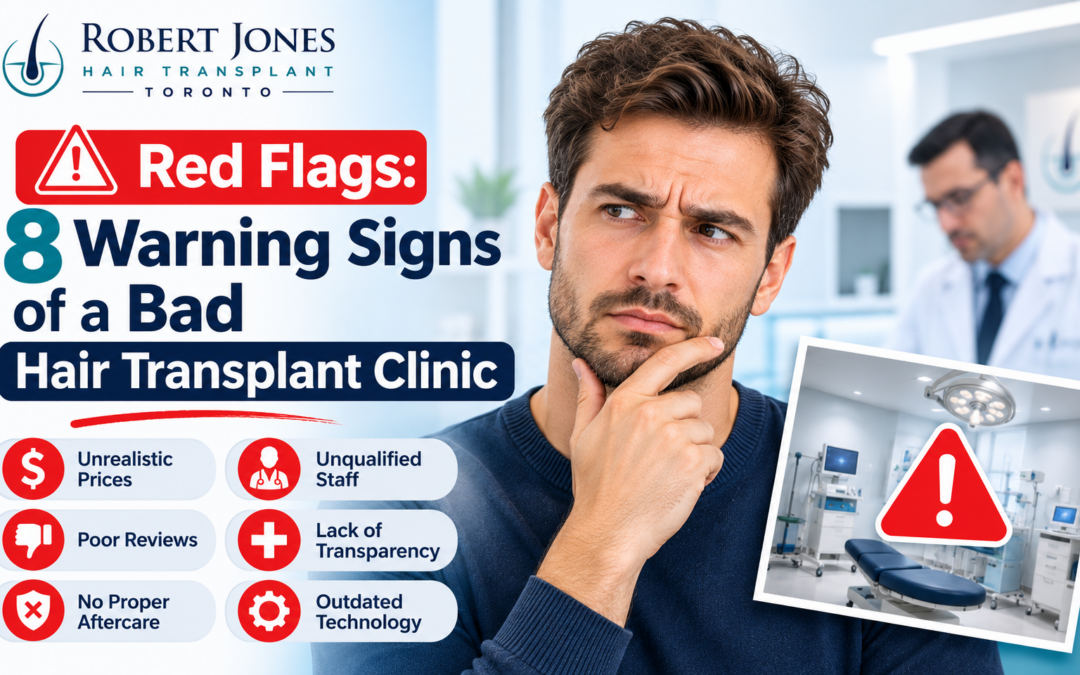
Here are eight red flags to watch for when choosing a hair transplant clinic in Canada.
1. The clinic does not clearly identify the surgeon
One of the first things to check is who will be responsible for your hair transplant.
Some clinics promote their brand, facilities and treatment packages but provide very little information about the physician involved. Others may feature a doctor’s photograph without clearly explaining their role in the patient’s treatment.
Before booking, find out:
- Who will assess your hair loss?
- Who will recommend the treatment?
- Who will design your hairline?
- Who will perform the surgical steps?
- Who will supervise your care and manage any complications?
A qualified medical professional should be responsible for the appropriate medical and surgical aspects of your treatment, in accordance with local licensing and scope-of-practice requirements.
In Ontario, you can check a physician’s registration through the College of Physicians and Surgeons of Ontario (CPSO) public register.
If a clinic cannot clearly identify the physician responsible for your care, take time to investigate before proceeding.
2. The clinic promises guaranteed results
Hair transplantation can improve hair coverage in suitable patients, but individual results vary.
The outcome depends on several factors, including donor hair availability, the pattern of hair loss, surgical planning, healing and individual hair growth.
Be cautious if a clinic promises:
- 100% graft survival.
- Guaranteed hair growth.
- A completely natural result for every patient.
- A specific number of grafts without assessing your scalp.
- Permanent protection against future hair loss.
No responsible clinic should guarantee an exact cosmetic outcome.
A proper consultation should explain what may be achievable, what limitations exist and what factors could affect the final result.
3. The clinic recommends surgery without properly assessing your hair loss
Hair loss does not have the same cause or pattern in every person.
Some patients experience hereditary hair loss, while others may have thinning associated with medical conditions, hormonal changes or other factors.
A clinic should assess your hair-loss history, scalp condition, donor area and overall suitability before recommending surgery.
Be cautious if the consultation consists mainly of a quick conversation, a graft estimate and a price quotation.
A proper assessment should consider:
- The pattern and progression of hair loss.
- The density and quality of donor hair.
- Existing hair in the recipient area.
- Scalp health and relevant medical history.
- Whether non-surgical treatment should be considered.
- How future hair loss could affect the result.
A hair transplant is not appropriate for everyone. A clinic that recommends surgery without understanding your circumstances may not be giving you enough information to make an informed decision.
4. The clinic promises unlimited grafts or unusually large sessions
Grafts are small units of hair follicles taken from a donor area and transplanted into areas affected by hair loss.
The donor supply is limited. Once follicles are removed, they cannot simply be replaced with new donor hair.
This makes donor management an important part of long-term hair restoration planning.
Be cautious if a clinic advertises unlimited grafts or recommends a very large transplant without carefully examining your donor area.
Excessive harvesting can leave visible thinning, patchiness or scarring in the donor region. It may also reduce the options available if you need another procedure later.
A responsible treatment plan should consider how much donor hair is available and how it can be used appropriately over time.
The goal should not simply be to transplant as many grafts as possible. It should be to develop a treatment plan that considers your current hair loss and potential future changes.
5. Unlicensed or unqualified staff perform surgical procedures
This is one of the most important issues to investigate before choosing a hair transplant clinic.
Hair transplantation is surgery, even when it involves small incisions and minimally invasive techniques. It requires medical assessment, surgical judgment and an understanding of scalp anatomy.
Some clinics may rely heavily on technicians while the advertised physician has limited involvement in the actual procedure.
Ask the clinic exactly who will perform each part of your surgery, including:
- Donor hair harvesting.
- Recipient site creation.
- Hairline design.
- Graft placement.
- Anaesthesia and patient monitoring.
- Post-operative assessment.
Also ask about the qualifications and licensing of everyone involved.
The International Society of Hair Restoration Surgery (ISHRS) warns patients about the risks of unlicensed personnel performing surgical aspects of hair restoration. However, the legal scope of practice can vary by jurisdiction. In Ontario, the clinic should be able to explain how each person’s role complies with applicable professional requirements.
Do not rely only on a clinic’s statement that a doctor will be present. Find out what the physician will actually do.
6. The clinic pressures you to book immediately
Hair transplant surgery should involve careful consideration, not a rushed decision.
Be cautious if a clinic repeatedly uses limited-time offers, discounts or additional graft packages to encourage you to book immediately.
Examples of concerning sales tactics include:
- Discounts that expire within a few hours.
- Pressure to pay a deposit before receiving a proper assessment.
- Offers of extra grafts if you book immediately.
- Limited-time packages that discourage further research.
- Reluctance to let you compare treatment options.
A hair transplant is a significant decision with long-term implications. You should have enough time to understand the procedure, ask questions and review the proposed treatment plan.
A clinic should be willing to explain its recommendations without making you feel pressured to commit.
7. The clinic uses misleading before-and-after photographs
Before-and-after photographs can help patients understand the possible outcomes of hair restoration. However, not every image displayed online provides reliable evidence of a clinic’s results.
Some photographs may lack consistent lighting, angles, hair length or timelines. Others may not clearly establish whether the results belong to the surgeon being promoted.
When reviewing a clinic’s portfolio, consider asking:
- Are these photographs from actual patients treated by this clinic?
- Were the procedures performed by the physician responsible for my treatment?
- How long after surgery were the photographs taken?
- Are the lighting, angles and hair lengths consistent?
- Can I see examples involving a similar hair-loss pattern?
Be particularly cautious if a clinic refuses to explain where its photographs came from or relies entirely on promotional images.
Photographs can be useful, but they should be considered alongside the surgeon’s qualifications, treatment approach and patient care standards.
8. The clinic does not explain risks, costs or follow-up care
Your treatment plan should include more than the procedure itself.
Before agreeing to surgery, you should understand the possible risks, expected recovery process, total cost and arrangements for follow-up care.
A clinic should be willing to explain:
- Possible complications and side effects.
- What to expect during early recovery.
- When you can return to work and physical activities.
- How post-operative concerns will be handled.
- What appointments are included in the treatment package.
- Whether additional procedures may be needed in the future.
- The complete cost and any additional charges.
Be cautious if the clinic gives you a price without explaining what is included or provides little information about what happens after surgery.
Follow-up care matters because hair restoration does not end when the procedure is complete. Patients need appropriate guidance during healing and the months that follow.
Questions to ask before choosing a hair transplant clinic
A consultation is your opportunity to understand the clinic’s approach and decide whether you feel comfortable proceeding.
Consider taking this checklist to your appointment:
- Who will assess my hair loss and recommend treatment?
- What are the surgeon’s qualifications and experience in hair restoration?
- Who will perform each surgical step?
- How will you determine the number of grafts I need?
- What are the risks and limitations of the recommended procedure?
- What happens if my existing hair continues to thin?
- What aftercare and follow-up appointments are included?
- What is the complete cost of treatment?
Pay attention not only to the answers but also to how clearly the clinic explains them.
You should feel comfortable asking questions and have enough information to make your own decision.
How to choose a hair transplant clinic in Canada
Once you know the warning signs, you can approach your research more carefully.
Look for a clinic that provides clear information about its physician, treatment process and patient care.
Here are some useful steps:
Verify medical credentials: If your surgeon is practising in Ontario, use the CPSO public register to check their registration information.
Understand the surgeon’s involvement: Ask who will assess your hair loss, plan the procedure and perform each surgical step.
Review relevant experience: Look for experience with the technique being recommended, whether FUE or FUT.
Ask about donor management: A suitable treatment plan should consider your current donor supply and possible future hair loss.
Review real patient results: Look for consistent photographs and ask questions about the procedures and timelines behind them.
Understand the financial commitment: Request a clear breakdown of the procedure cost, included services and possible additional expenses.
Discuss aftercare: Make sure you understand who will support you during recovery and how to contact the clinic if concerns arise.
You can also review the ISHRS patient resources for additional guidance on selecting a hair restoration surgeon.
Consider your hair restoration options with Dr. Robert Jones
Choosing a hair transplant clinic is about more than comparing prices or looking at photographs. It means understanding who will be responsible for your care, how your procedure will be planned and what to expect over the long term.
Dr. Robert Jones provides hair restoration consultations at his Oakville practice for patients from Toronto, Burlington and surrounding Ontario communities.
The practice offers FUE and FUT hair transplantation, along with non-surgical hair restoration options. Treatment recommendations depend on individual factors, including hair-loss pattern, donor hair availability, existing hair and long-term goals.
Frequently asked questions
How can I tell if a hair transplant clinic is trustworthy?
Start by checking the physician’s qualifications, understanding who will perform the surgical steps and reviewing the clinic’s approach to medical assessment and aftercare. A trustworthy clinic should provide clear answers about risks, costs and expected outcomes without pressuring you to book.
Is it a red flag if technicians perform my hair transplant?
It is important to understand exactly what technicians and other staff members are permitted to do. Surgical incisions and other medical procedures require appropriately qualified and legally authorised professionals. Ask the clinic to explain each person’s role and verify that the arrangement complies with local requirements.
Should I avoid clinics that offer very low hair transplant prices?
Not necessarily. Pricing can vary for legitimate reasons, including the procedure, treatment requirements and services included. However, an unusually low price should prompt questions about the surgeon’s involvement, staff qualifications, graft planning and follow-up care.
Can a hair transplant clinic guarantee 100% graft survival?
No clinic should promise an exact graft survival rate or guaranteed cosmetic outcome for every patient. Results vary depending on individual circumstances, surgical factors and healing.
Why is donor area assessment important?
The donor area contains a limited supply of hair follicles. Taking too many grafts can cause visible thinning or scarring and may reduce the options available for future procedures. Proper donor assessment helps guide a more considered treatment plan.
Should I choose a clinic based only on before-and-after photographs?
No. Photographs can help you evaluate possible outcomes, but they do not tell you who performed the procedure or how the clinic manages patient care. Review them alongside medical credentials, surgical involvement, experience and follow-up arrangements.
What should I do if I feel pressured to book a procedure?
Take time to review your options and seek another medical opinion if necessary. You should not feel obligated to pay a deposit or schedule surgery before you understand the proposed treatment and its potential risks.