
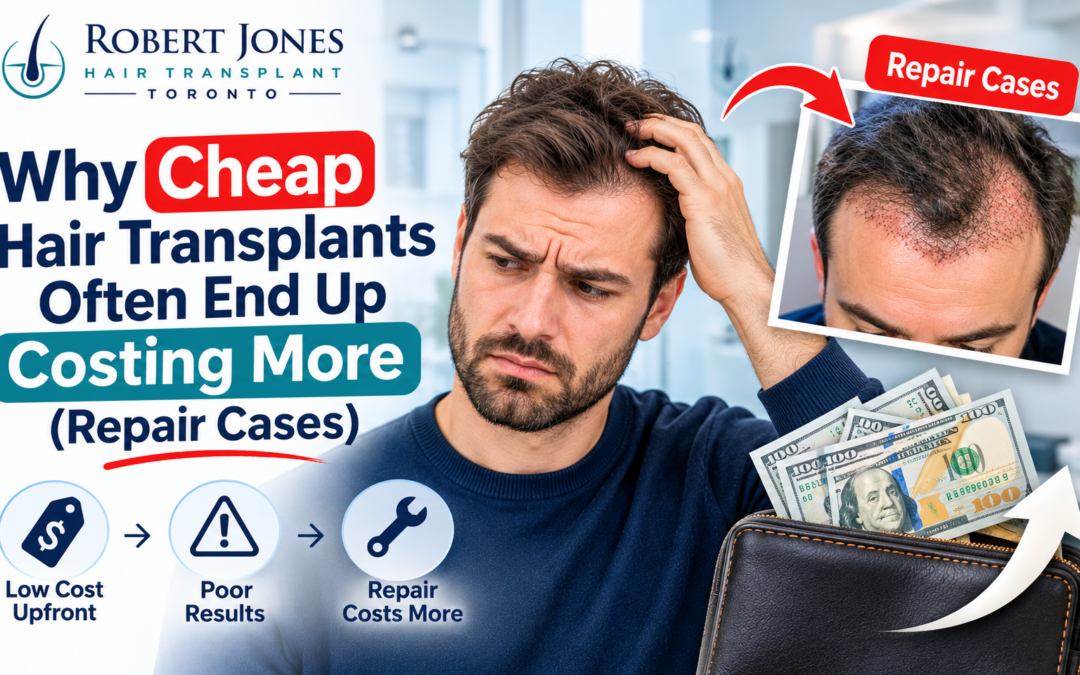
The advertised price of a hair transplant can be tempting, especially when several clinics offer similar procedures at very different costs. However, choosing a clinic based mainly on price can lead to problems that are difficult, expensive or sometimes impossible to correct.
Hair transplantation is a surgical procedure that requires careful planning, appropriate medical oversight and an understanding of how hair loss may progress over time. If the hairline is poorly designed, too many grafts are removed from the donor area or transplanted hair grows in an unnatural direction, the patient may be left considering corrective surgery.
This is one reason the initial price should not be the only factor when comparing hair transplant clinics.
For patients considering FUE or FUT in Canada, understanding the potential costs of repair procedures can help them make a more informed decision.
Why are some hair transplant clinics significantly cheaper?
Hair transplant prices can vary depending on the clinic’s location, operating costs, surgical technique, treatment requirements and the services included in the package.
A lower price does not automatically indicate poor-quality treatment. However, patients should understand what is included in the quoted cost and whether the clinic maintains appropriate medical and surgical standards.
The concern arises when a clinic reduces its prices by relying on high patient volumes, limited physician involvement or inadequate surgical planning.
The International Society of Hair Restoration Surgery (ISHRS) has raised concerns about clinics where unlicensed or inadequately trained personnel perform surgical procedures without appropriate physician involvement.
A lower initial price may not reflect the full cost of treatment if the patient later needs additional procedures to address poor growth, visible scarring or an unnatural appearance.
Before comparing prices, find out who will perform your surgery, how the procedure will be planned and what follow-up care is included.
7 ways a cheap hair transplant can become more expensive
The financial consequences of a poorly planned hair transplant are not always immediately visible. Some problems become apparent during recovery, while others develop as the transplanted hair grows or existing hair continues to thin.
Here are seven issues that may lead to additional treatment expenses.
1. Poor graft growth may require another procedure
One of the main reasons patients become dissatisfied with a hair transplant is insufficient growth in the recipient area.
Grafts need to be handled, prepared and implanted carefully. Problems during harvesting, graft storage, preparation or placement may affect their survival.
If the transplanted area develops less coverage than expected, patients may consider another procedure to improve density.
However, another transplant is not always the answer. The surgeon must first determine why the original grafts did not produce the expected result and whether enough healthy donor hair remains.
A second procedure may involve additional surgical fees, recovery time and further demands on the donor area.
2. An unnatural hairline can be difficult to correct
Hairline design plays an important role in the overall appearance of a hair transplant.
A hairline that sits too low, looks excessively straight or contains large grafts along the front may appear unnatural. Incorrect hair direction and spacing can also make transplanted hair difficult to style.
Corrective treatment may involve:
- Removing selected grafts.
- Softening the frontal hairline.
- Repositioning or redistributing suitable grafts.
- Adding single-hair grafts to create a more gradual transition.
- Addressing visible irregularities or scarring.
The type of correction depends on the original problem and the condition of the scalp.
Some patients may need more than one treatment to achieve a satisfactory improvement. Even then, complete restoration of a natural appearance may not be possible.
3. Overharvesting can damage the donor area
The donor area, usually located at the back and sides of the scalp, provides the follicles used during transplantation.
This hair supply is limited. Once follicles are removed, they are no longer available in their original locations.
If a clinic extracts too many grafts or distributes the extractions poorly, the donor area may develop visible thinning, patchiness or scarring.
This is particularly concerning with FUE (Follicular Unit Extraction), where individual follicular units are removed from the scalp.
Repairing an overharvested donor area can be difficult because the original hair supply cannot simply be replaced.
Possible approaches may include:
- Carefully planned transplantation into selected depleted areas.
- Scalp micropigmentation to reduce the visual contrast between hair and scalp.
- Other cosmetic treatments to improve the appearance of scars.
These options have limitations. Additional transplantation requires suitable donor hair, while scalp micropigmentation creates the appearance of density rather than restoring actual hair.
In severe cases, the damage may be permanent.
4. Visible scars may require corrective treatment
Both FUE and FUT involve changes to the donor area.
FUE creates small extraction scars, while FUT leaves a linear scar where a strip of scalp is removed and the wound is closed.
When harvesting or wound closure is poorly managed, scars may become more noticeable.
Patients may seek treatment if they experience:
- Widened FUT scars.
- Visible FUE extraction marks.
- Uneven donor-area density.
- Raised or depressed scars.
- Scarring that makes shorter hairstyles difficult.
Scar revision or transplantation into selected scar tissue may be considered in suitable cases. However, scar tissue does not always behave like normal scalp, and additional treatment cannot guarantee that the area will look completely natural.
A patient who chooses a clinic based only on its initial price may later face expenses for procedures that were not part of the original treatment plan.
5. Poor surgical planning can create problems as hair loss progresses
Hair loss is often a gradual process. A transplant may improve the appearance of the hairline or crown, but it does not prevent surrounding natural hair from continuing to thin.
This is particularly important for younger patients or people with progressive hereditary hair loss.
If the initial hairline is designed too aggressively or too many grafts are used in one area, fewer donor follicles may remain for future treatment.
As existing hair continues to recede, the transplanted area may become isolated or look disconnected from the surrounding hair.
Corrective treatment may then require additional grafts, a revised hairline design or other approaches to improve the overall balance.
Long-term planning is important because the goal should be to create an appropriate result that considers both current hair loss and possible future changes.
6. Poor hair direction and graft placement may need correction
A successful transplant is not only about how many grafts grow. Their position, angle and direction also influence the final appearance.
If grafts are placed at inappropriate angles, hair may grow outward or stand too upright. Large grafts positioned along the frontal hairline can also create a pluggy appearance.
Correcting these problems can be challenging because the surgeon may need to remove selected grafts, address existing scars and carefully plan new recipient sites.
Additional grafts alone may not solve the problem. In some cases, removal or redistribution of existing grafts must be considered first.
7. Limited aftercare can lead to additional medical expenses
Hair transplant care does not end when the surgical procedure is complete.
Patients need clear instructions about washing, sleeping, physical activity, scalp protection and follow-up appointments.
A clinic that provides limited post-operative guidance may leave patients uncertain about what is normal during recovery and when they should seek medical attention.
Potential concerns such as persistent inflammation, infection, unusual swelling or abnormal healing should be assessed by an appropriate healthcare professional.
Additional consultations, medical treatment or corrective procedures may create expenses that were not included in the original package.
Before booking, ask who will be responsible for your follow-up care and how the clinic handles post-operative concerns.
What does hair transplant repair surgery involve?
Hair transplant repair surgery is performed to improve the appearance or address problems caused by a previous procedure.
The appropriate approach depends on what went wrong during the original treatment.
For example, someone with an unnatural hairline may require a different correction from someone with extensive donor-area depletion.
Some repair options include:
| Previous problem | Possible corrective approach |
| Unnatural hairline | Hairline revision or selected graft removal |
| Poor graft growth | Assessment of remaining donor supply and possible additional transplantation |
| Overharvested donor area | Limited transplantation or scalp micropigmentation in selected cases |
| Visible scarring | Scar revision, transplantation into scars or cosmetic camouflage |
| Incorrect hair direction | Selected graft removal and carefully planned reconstruction |
| Poor density | Additional graft placement when suitable donor hair remains |
Not every problem can be corrected through another hair transplant. The surgeon must assess the scalp, remaining donor supply and condition of existing grafts before recommending treatment.
In some cases, a limited cosmetic correction may be more appropriate than another extensive procedure.
Why repair cases can be more complicated than the first hair transplant
A first-time hair transplant is generally planned using the patient’s available donor supply and the condition of an untreated recipient area.
Repair surgery is different because the scalp has already undergone one or more procedures.
Previous surgery may have resulted in:
- Reduced donor hair availability.
- Scar tissue in the recipient area.
- Changes in scalp circulation and tissue quality.
- Poorly positioned or incorrectly angled grafts.
- Permanent extraction marks.
- Limited options for future transplantation.
These factors can make corrective procedures more demanding.
The surgeon must understand what happened during the earlier procedure and determine which areas can safely be treated again.
According to the ISHRS, some patients with extensive damage may need multiple corrective procedures. Others may have limited options because too much donor hair has already been removed.
This is why repair surgery should never be presented as a guaranteed way to reverse an unsuccessful transplant.
How to compare hair transplant prices without overlooking quality
Price is a reasonable factor to consider when planning a hair transplant. However, comparing clinics only by the total cost can leave important questions unanswered.
Instead, ask what you are receiving for the quoted price.
Check who will perform the procedure
Find out who will assess your hair loss, design the hairline, perform the surgical steps and supervise your care.
Ask about the qualifications and professional registration of the physician responsible for your treatment.
Understand the proposed graft count
The number of grafts should be based on an assessment of your donor area and recipient area.
Be cautious if a clinic promises an unusually high number of grafts without examining your scalp.
Ask about the treatment plan
A proper consultation should consider your current hair loss, donor supply and possible future thinning.
The clinic should explain why a particular technique is being recommended and what limitations may apply.
Review the full cost
Ask whether the quoted price includes:
- Consultation and assessment.
- Surgical fees.
- Anaesthesia and facility charges.
- Post-operative instructions and supplies.
- Follow-up appointments.
- Additional services or medications, if applicable.
This helps you understand the actual financial commitment rather than relying on an advertised starting price.
Look for relevant patient results
Review before-and-after photographs and ask whether the examples involve patients with a similar hair-loss pattern and treatment plan.
Photographs should be viewed alongside information about the surgeon’s qualifications, surgical involvement and patient follow-up.
Questions to ask before choosing a hair transplant clinic
Before making a decision, consider asking these questions during your consultation:
- Who will personally assess my hair loss and recommend treatment?
- Who will perform the surgical steps?
- How will you determine the appropriate number of grafts?
- How will my donor area be protected for possible future procedures?
- What are the risks and limitations of the recommended technique?
- What happens if the transplanted hair does not grow as expected?
- What follow-up care is included in the quoted price?
- Can I review results from patients with similar hair-loss patterns?
A clinic should be willing to explain its approach and give you enough time to consider your options.
You should not feel pressured to book surgery because of a limited-time discount or an unusually low package price.
Considering hair restoration with Dr. Robert Jones
The cost of a hair transplant should be considered alongside the surgical planning, medical oversight and long-term treatment approach.
Dr. Robert Jones provides hair restoration consultations at his Oakville practice for patients from Toronto, Burlington and surrounding Ontario communities.
The practice offers FUE and FUT hair transplantation, along with non-surgical hair restoration options. Treatment recommendations depend on individual factors, including hair-loss pattern, donor hair availability, existing hair and long-term goals.
If you are considering a hair transplant, a consultation can help you understand the available options, discuss the proposed treatment and ask questions about the procedure and recovery process.
Practice location:
1495 Cornwall Rd., Suite 31
Oakville, Ontario L6J 0B2
Phone: (905) 236-1048
Contact the practice to discuss your hair restoration goals and arrange a consultation.
Frequently asked questions
Are cheap hair transplants always bad?
No. A lower price does not automatically indicate poor-quality treatment. Costs can vary because of location, operating expenses and the services included. The important thing is to understand whether the clinic maintains appropriate medical oversight, surgical standards and patient care.
Why do some patients need hair transplant repair surgery?
Patients may seek repair because of poor graft growth, an unnatural hairline, visible scarring, incorrect hair direction or donor-area overharvesting. Continued natural hair loss can also change the appearance of an initially satisfactory transplant.
Is hair transplant repair more expensive than the original procedure?
It can be. Repair surgery may require additional assessment, more complex surgical planning and multiple procedures. The cost depends on the original problem, the condition of the scalp and the treatment required.
Can an overharvested donor area be repaired?
Some donor-area problems may be improved through carefully planned transplantation or scalp micropigmentation. However, these treatments have limitations and cannot fully replace follicles that were permanently removed. Severe donor depletion may not be correctable.
Can an unnatural hairline be corrected?
In selected cases, yes. Treatment may involve removing certain grafts, softening the hairline or adding carefully placed grafts. The appropriate approach depends on the original design, hair direction, scarring and available donor hair.
How can I avoid needing hair transplant repair surgery?
Start by choosing a qualified physician, understanding who will perform each surgical step and receiving an appropriate assessment before treatment. Long-term donor management, realistic expectations and clear aftercare are also important.
Should I choose a hair transplant clinic based on graft price?
The price per graft does not explain the quality of surgical planning or the level of medical involvement. Compare the complete treatment plan, surgeon’s role, donor management, follow-up care and total cost before making a decision.